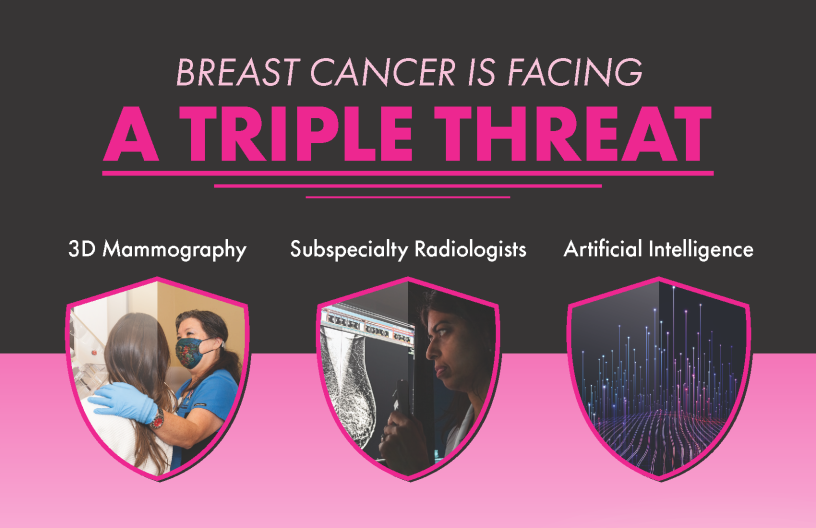
When you have your mammogram performed at the Huntington-Hill Breast Center in Arcadia or one of our Huntington-Hill Breast & Imaging Centers in Cordova, Glendora or West Covina, you will be comfortable knowing that our physicians and support staff are highly experienced and trained. We perform more than 40,000 screening mammograms, and over 10,000 diagnostic evaluations of women with breast problems per year. We also provide excellent mammogram accuracy thanks to our nationally respected team of breast radiologists and our computer aided detection (CAD) program. It provides secondary interpretations of every mammogram film that our experienced team of radiologists uses as a back-up evaluation. In addition, our physicians, technologists, and state-of-the-art equipment are certified and accredited by the American College of Radiology (ACR), the FDA, and the National Accreditation Program for Breast Centers (NAPBC).
The American Cancer Society recommends the use of three tests for breast cancer detection in asymptomatic women.
- Digital mammography
- Clinical breast exams by a physician or other health care professional
- Monthly breast self-examination (BSE)
While no test can find 100% of breast cancers, the combination of tests offers women the best possible chance of early detection.
The bottom line is that early detection is the key to beating breast cancer. Additionally, annual screening results in lower recall rates than does biennial screening and finds cancer at the earliest stage – providing a more favorable prognosis. The American College of Radiology, the Society of Breast Imaging and many major cancer organizations, strongly recommend women begin their annual screening mammography routine at age 40, and that women with a family history of breast cancer consult with their primary care physician about when to get their baseline mammogram and if additional imaging is needed. You should talk to your primary care clinician about when to start and how often you should have a mammogram.
Current recommendations suggest starting annual screening mammograms at age 40 (for average risk women). Some may need to start earlier.
Discuss family history and risk factors with your physician. Patients who have a mom or sister with premenopausal breast cancer usually begin the screening process ten years before the age of a family member’s diagnosis. For example, if Mom was diagnosed at age 45, you should start screening at age 35.
You can prepare for your mammogram by following the below suggestions:
- Do not use deodorant, powder, or lotion under your arms or on your breast before your mammogram
- Wear a blouse or top that is easy to remove
- Be prepared to complete a series of questions about your medical history
- Inform your technologists if you have breast implants or might be pregnant
Calcification
Calcifications are tiny mineral deposits within the breast tissue, which appear as small white spots on the images. Calcifications are divided into two categories, macrocalcifications and microcalcifications.
Macrocalcification
Macrocalcifications are coarse (larger) calcium deposits that are associated with benign (non-cancerous) conditions and do not require a biopsy. They most likely represent degenerative changes in the breasts, such as aging of the breast arteries, old injuries, or scarring from other causes. Macrocalcifications are found in about 50% of women over the age of 50, and in about 10% of women under the age of 50.
Microcalcification
Microcalcifications are tiny (less than 1/50 of an inch) specks of calcium in the breast that may appear singly or in clusters. An area of microcalcification that is seen on a mammogram does not always mean that breast cancer is present. The shape and arrangement of microcalcifications help the radiologist judge the likelihood of breast cancer being present. In some cases, the microcalcifications do not even indicate a need for a breast biopsy. Instead, a doctor may advise a follow-up mammogram within 3 to 6 months. In other cases, the microcalcifications are more suspicious and a biopsy is recommended to determine if cancer is present.
Mass
A mass is an important change seen on mammograms. Masses may occur with or without associated calcifications and can be due to many things, including cysts. A cyst, which is a benign collection of fluid in the breast, cannot be diagnosed by a physical exam alone nor can it be diagnosed by digital mammography alone. To confirm that a mass is a cyst, either breast ultrasound or aspiration with a needle is required. If a mass is not a cyst, then further imaging may be obtained. As with calcifications, a mass can be caused by benign breast conditions or by breast cancer. Some masses can be monitored with periodic digital mammography and/or ultrasound, while others may require immediate or delayed breast biopsy. The size, shape, and margins (edges) of the mass help the radiologist in evaluating the likelihood of breast cancer. Breast ultrasound is often helpful. Prior mammograms may help show that a mass is unchanged for many years, indicating a benign condition and helping to avoid unnecessary breast biopsy.
Digital mammography cannot prove that an abnormal area is breast cancer. If digital mammography raises a significant suspicion of breast cancer, tissue must be removed for examination under the microscope to tell if it is cancer with certainty. This can be done with needle biopsy or open surgical biopsy.

We have four locations that offer a combination of breast imaging services:
- Huntington-Hill Breast Center – Arcadia offers 2D and 3D Screening.
- Huntington-Hill Imaging Center – Cordova offers 2D and 3D Screening Mammography.
- Huntington-Hill Imaging Center – Glendora offers 2D and 3D Screening Mammography.
- Huntington-Hill Imaging Center – West Covina offers 2D Screening Mammography.
We require a referral for screening mammograms from your primary healthcare provider, because we are required to send a report to your provider. This helps us ensure your report gets to the correct primary provider. Speak to your primary care provider (PCP) or women’s health professional (OB-GYN) for guidance on your specific needs.
Most insurance plans cover a screening mammogram (including 3D) every year. Deductibles and out-of-pocket expenses vary per insurance company for diagnostic mammograms. It’s important to call your insurance company to see if your mammogram is covered.